


Ed Gein
Net Worth $4700
August 27, 1906
Virgo
La Crosse, United States of America
Death Date: July 26, 1984 (age 77)
Politician
$4700
Male
5 ft 7 in (170 cm)
#85
Net Worth RankEd Gein Biography — True Story, Crimes, Arrest, Trial & Legacy
A note before we begin: this article covers a real criminal case. It is presented for historical and educational purposes, drawing on court records, biographical archives, and established journalism. It does not glorify violence, and it avoids graphic detail beyond what is necessary to understand the case's historical and cultural significance.

Who Was Ed Gein?
Few names in American criminal history carry as much cultural weight as Ed Gein. Unlike many notorious criminals, he isn't remembered primarily for a high body count. Instead, he's remembered for something arguably more disturbing: the way his crimes reshaped horror storytelling for generations.
His case directly inspired some of the most iconic villains in film history, including Norman Bates in "Psycho," Leatherface in "The Texas Chain Saw Massacre," and Buffalo Bill in "The Silence of the Lambs." Decades later, his story continues to resurface in documentaries, dramatized series, and true-crime retrospectives, most recently through Netflix's dramatized anthology series exploring his life.
Understanding why his case became so culturally significant requires looking closely at his upbringing, the isolation he experienced, and the psychological unraveling that followed the death of the one person who dominated his entire world: his mother.
Early Life and Family Background
Birth and Childhood
Edward Theodore Gein was born on August 27, 1906, in La Crosse County, Wisconsin. He was the younger of two sons born to George and Augusta Gein. In 1914, when Ed was still a young child, the family relocated to a secluded farm near Plainfield, Wisconsin, a move that would come to define nearly his entire life.
His father, George, struggled with alcoholism and held little authority within the household. Consequently, the family's finances and discipline fell almost entirely under the control of his mother, Augusta, a devoutly religious woman whose influence over her sons was extraordinarily controlling.
A Domineering Mother
Augusta Gein ran the household with rigid, fire-and-brimstone religious conviction. She frequently preached to her sons about the sinfulness of the world, particularly regarding women, whom she described as inherently immoral apart from herself. As a result, Ed grew up with an almost paralyzing fear of female sexuality, coupled with an intense, unhealthy devotion to his mother.
She actively discouraged any friendships or social interactions Ed attempted to form, particularly with girls his age. Because of this isolation, he had virtually no normal social development during his childhood or adolescence, a factor that many biographers later pointed to as foundational to his psychological deterioration.
Life on the Farm
The family's farm outside Plainfield was remote, and the Geins largely kept to themselves. Ed and his older brother, Henry, attended school, though Ed reportedly struggled socially and academically, often ridiculed by classmates for his odd mannerisms.
Despite this, some teachers and neighbors described him as intelligent, with a good memory and genuine curiosity, particularly about anatomy and, unsettlingly, about death and human physiology.
Tragedy Strikes the Gein Family
The Death of His Father
George Gein died in 1940, further consolidating Augusta's control over the household and her two adult sons. By this point, Ed and Henry worked odd jobs around Plainfield while continuing to live under their mother's roof and rules.
His Brother's Mysterious Death
In 1944, tragedy struck again when Henry died while the two brothers were fighting a fire on their property. Investigators at the time ruled the death accidental, attributing it to smoke inhalation or heart failure. However, some details of the case have raised lingering questions among later investigators.
Henry's body was found in an area of the field that had already burned out, and he had bruising on his head that was never fully explained. Because Henry had reportedly begun criticizing their mother's influence over Ed shortly before his death, some true-crime researchers have speculated, though never proven, that Ed may have played a role in his brother's demise.
The Death That Changed Everything
The most pivotal event in Ed Gein's life came in 1945, when Augusta died following a series of strokes. Her death left him utterly alone for the first time in his life, without the domineering presence that had structured his entire existence.
Rather than moving forward, he responded by preserving her memory in an increasingly disturbing way. He sealed off the rooms of the house that she had used most, including her bedroom and the parlor, turning them into an untouched shrine. He continued living in the farmhouse, but confined himself largely to a single small room, while the rest of the house was left to decay around him.

The Descent Into Isolation and Delusion
Life Alone on the Farm
Following his mother's death, neighbors in Plainfield noted that Ed became increasingly withdrawn and eccentric, though most still considered him harmless. He worked occasional handyman jobs and was known locally as a quiet, somewhat odd but generally cooperative man who occasionally babysat neighborhood children.
Behind this quiet public image, however, his mental state was deteriorating in ways no one around him fully recognized. He later described entering trance-like states during this period, and investigators would eventually connect these episodes to disturbing activities taking place away from public view.
Grave Robbing Begins
Between approximately 1947 and 1952, Gein began visiting local cemeteries at night, exhuming the bodies of recently buried women, particularly those who resembled his mother in age or appearance. He later told investigators that he sometimes worked with an accomplice, though this claim was never substantiated.
He took remains from these graves back to his farmhouse, where he used skin, bones, and other body parts to construct household items and clothing. Investigators later found chairs upholstered with human skin, skull-based objects, and other items crafted from remains recovered from area cemeteries, spanning as many as nine to forty desecrated graves depending on the estimate.
The Murders
Mary Hogan (1954)
On December 8, 1954, Mary Hogan, a tavern owner in the nearby community of Pine Grove, disappeared. Investigators found blood on the tavern floor, but with no body and no immediate suspect, the case went cold for years.
It wasn't until Gein's later arrest that authorities connected him to Hogan's disappearance, after her remains were discovered among the items in his farmhouse.
Bernice Worden (1957)
The case that finally brought Ed Gein's crimes to light involved Bernice Worden, who ran a hardware store in Plainfield. On November 16, 1957, she went missing from her store, and her son quickly grew suspicious of Gein, who had been in the store shortly before her disappearance and had mentioned returning later that day.
Local police visited Gein's farm that evening. In a shed on the property, they discovered Worden's body, which had been decapitated and mutilated after her death. Inside the farmhouse itself, investigators uncovered a horrifying scene: numerous human remains, including skulls repurposed as bowls, a suit fashioned from human skin, and boxes containing preserved organs.
The Investigation Expands
As word of the discovery spread, investigators began connecting Gein to Mary Hogan's earlier disappearance and to a string of grave desecrations across local cemeteries. During questioning, Gein confessed to shooting both Worden and Hogan, though he claimed much of what followed occurred in a dissociative, trance-like state that he struggled to fully recall.
He was formally charged with first-degree murder in Worden's death, a case that would take more than a decade to resolve due to questions surrounding his mental competency.
Arrest, Trial, and Insanity Ruling
Initial Competency Hearing
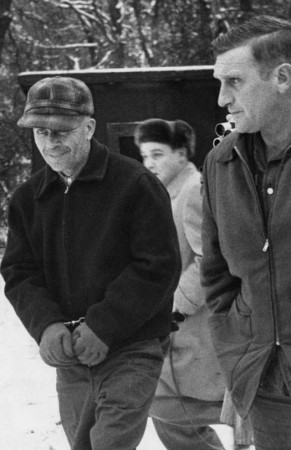
Following his arrest, Gein's defense attorney entered a plea of not guilty by reason of insanity. In January 1958, a court found him unfit to stand trial after psychiatric evaluations diagnosed him with schizophrenia. As a result, he was committed to the Central State Hospital for the Criminally Insane in Waupun, Wisconsin, rather than immediately facing trial.
A Decade of Institutionalization
Gein remained institutionalized for roughly a decade before authorities revisited his case. During this period, he reportedly cooperated with hospital staff, working various jobs within the facility, including as a mason and carpenter's assistant.
The 1968 Trial
By 1968, doctors determined that Gein was competent to stand trial, and proceedings finally moved forward for the murder of Bernice Worden. The trial was conducted in two phases: first to determine guilt, and second to determine his mental state at the time of the crime.
The court found him guilty of first-degree murder. However, during the sanity phase of the trial, he was found not guilty by reason of insanity, meaning he would not serve a traditional prison sentence. Instead, he was returned to psychiatric custody rather than a conventional correctional facility.
Return to Institutional Care
Following the 1968 ruling, Gein spent the remainder of his life within Wisconsin's mental health system. He was later transferred to the Mendota Mental Health Institute in Madison, a minimum-security psychiatric facility, where he lived out his final years under continued psychiatric supervision.
The Fate of the Gein Farmhouse
A Site of Morbid Curiosity
News of the discoveries at Gein's farm spread rapidly, and the property quickly became a magnet for curious onlookers, journalists, and even souvenir hunters. Local authorities struggled to manage the crowds that descended on Plainfield in the weeks following his arrest.
Destroyed by Fire
In 1958, the farmhouse burned down under circumstances that were never fully explained. Some residents at the time speculated that the fire was deliberately set by locals hoping to erase the property's grim notoriety, though no one was ever charged in connection with the blaze.
Death and Final Years
Later Life in Custody
Gein spent his final years largely out of public attention, living within the psychiatric care system for close to three decades following his 1957 arrest. Hospital staff during this period generally described him as calm, cooperative, and intelligent, a stark contrast to the horror associated with his name.
Passing in 1984
Ed Gein died on July 26, 1984, in Madison, Wisconsin, at the age of 77, following respiratory and heart failure. He was buried in Plainfield Cemetery, in the same town where his crimes had taken place decades earlier, near the graves of the family members whose deaths had so profoundly shaped his life.
His headstone was later stolen and, though eventually recovered, has since been removed from public display due to repeated vandalism and theft attempts by souvenir seekers.
Psychological Analysis of the Case
Diagnosis and Expert Interpretation
Psychiatric evaluations during his competency hearings diagnosed Gein with schizophrenia, along with symptoms consistent with severe dissociative episodes. Investigators and later researchers have widely attributed his behavior to an extreme, unresolved grief response tied to his mother's death, compounded by decades of enforced isolation and psychological control during his upbringing.
Some behavioral analysts have specifically characterized his grave-robbing activities as an attempt to symbolically resurrect his mother, rather than behavior driven primarily by sexual motivation, distinguishing his case from many other notorious criminal profiles.
Why His Case Became a Landmark
Beyond the specifics of his crimes, Gein's case became legally significant because of how it tested the boundaries of criminal insanity law in the United States. The extended gap between his 1957 arrest and his 1968 trial highlighted ongoing questions about how the justice system should handle defendants found incompetent to stand trial, questions that continued shaping mental health and criminal law discussions for years afterward.

Ed Gein's Lasting Influence on Popular Culture
Inspiration Behind Norman Bates
Author Robert Bloch, who lived not far from Plainfield at the time of Gein's arrest, drew inspiration from the case when writing his novel "Psycho," later adapted into Alfred Hitchcock's landmark 1960 film. The character of Norman Bates, particularly his unhealthy attachment to his deceased mother, closely mirrors elements of Gein's own psychological profile.
The Texas Chain Saw Massacre
Director Tobe Hooper has cited Gein's crimes as a key inspiration behind "The Texas Chain Saw Massacre," particularly the character Leatherface, whose use of human-skin masks directly echoes items investigators found in Gein's farmhouse.
Buffalo Bill in The Silence of the Lambs
Author Thomas Harris also drew on aspects of Gein's case when creating the character Buffalo Bill for "The Silence of the Lambs," particularly the character's practice of fashioning garments from human skin, a detail lifted almost directly from the historical case file.
Modern Retellings
Interest in his story has continued well into the streaming era. Netflix's dramatized anthology series revisited his case as part of a broader true-crime franchise, reigniting public fascination with the psychological and cultural dimensions of his story decades after his death.
How Plainfield Saw Him Before the Arrest
A "Harmless" Neighbor
Before his arrest, most residents of Plainfield viewed Ed Gein as an odd but generally unthreatening presence in the community. He was frequently hired for small handyman jobs, and several families reportedly trusted him enough to leave him alone with their children on occasion, a detail that, in hindsight, deeply unsettled the town once the truth came to light.
Neighbors later recalled him as soft-spoken and somewhat withdrawn, someone who rarely initiated conversation but responded politely when spoken to. This ordinary, unremarkable public persona is part of why the discoveries at his farm shocked the community so profoundly; almost no one suspected the extent of what was happening behind closed doors.
Rumors and Local Gossip
In the years leading up to his arrest, occasional rumors circulated about Gein's strange habits, including comments about his interest in anatomy books and medical oddities. However, these rumors were generally dismissed as harmless eccentricity rather than taken as warning signs.
Looking back, several locals noted that Gein occasionally made unsettling comments about death or the human body during casual conversation, remarks that were largely brushed aside at the time but were later reexamined with much greater concern.
Legal Legacy: How the Case Shaped Insanity Law
Rethinking Competency Standards
Gein's decade-long wait between arrest and trial forced Wisconsin's legal system to confront difficult questions about how long a defendant found incompetent to stand trial could remain in limbo. His case became frequently cited in later legal discussions about balancing public safety with a defendant's constitutional right to a timely trial.
Influence on Forensic Psychology
The extensive psychiatric evaluation conducted throughout his case contributed to a broader understanding of dissociative behavior linked to trauma and extreme grief. Later behavioral science research, including work conducted by federal profiling units, referenced his case when studying ritualistic offender behavior, helping shape early frameworks for what would eventually become modern criminal profiling.
A Reference Point for Later Cases
Decades later, legal scholars and forensic psychologists continued referencing the Gein case when examining the insanity defense more broadly. Few cases from the era combined such extensive physical evidence with such a clear psychiatric narrative, making it a frequently cited teaching example in law schools and forensic psychology programs alike.
Media Coverage and Public Reaction in 1957
National Headlines
When news of the farmhouse discoveries broke in November 1957, newspapers across the country ran extensive coverage, often struggling to describe the details without alarming readers further. At a time before modern true-crime media existed, the case represented one of the first instances of a small-town crime capturing sustained national attention.
Impact on Plainfield
For the town of Plainfield itself, the case brought unwanted notoriety that lingered for years. Some residents reported feeling exploited by outside journalists and curious visitors, while others worried the case would permanently define their community's reputation.
Local leaders eventually pushed back against the constant stream of visitors seeking to see the farm or purchase souvenirs, viewing the ongoing fascination as disrespectful to Worden's and Hogan's families.
Books, Documentaries, and Further Retellings
Early Literary Influence
Beyond Robert Bloch's "Psycho," Gein's case has been referenced or loosely adapted in numerous novels and screenplays over the decades, cementing his status as one of the most frequently referenced true-crime cases in American fiction.
Documentary Coverage
Various documentary series have revisited the case over the years, typically focusing on court records, psychiatric evaluations, and interviews with historians or law enforcement officials involved in the original investigation. These retrospectives generally aim to separate documented fact from decades of exaggerated folklore that grew around his story.
Continued Fascination
Even nearly seven decades after his arrest, Gein's case continues generating new books, podcast episodes, and streaming adaptations, reflecting an enduring public interest in understanding how such extreme psychological deterioration could occur largely unnoticed within a small, tight-knit community.
Complete Timeline of Key Events
| Year | Event |
|---|---|
| 1906 | Edward Theodore Gein is born in La Crosse County, Wisconsin. |
| 1914 | The Gein family relocates to a farm near Plainfield, Wisconsin. |
| 1940 | His father, George Gein, dies. |
| 1944 | His brother, Henry, dies in a fire under circumstances later questioned by investigators. |
| 1945 | His mother, Augusta, dies, leaving Ed alone on the farm. |
| 1947–1952 | Gein begins exhuming bodies from local cemeteries. |
| Dec. 1954 | Mary Hogan disappears; Gein is later linked to her death. |
| Nov. 16, 1957 | Bernice Worden disappears; police discover her body and other remains on Gein's farm. |
| Jan. 1958 | Gein is found unfit to stand trial and diagnosed with schizophrenia. |
| 1958 | The Gein farmhouse burns down under unexplained circumstances. |
| 1968 | Gein is found competent to stand trial, convicted of first-degree murder, then found not guilty by reason of insanity. |
| July 26, 1984 | Ed Gein dies in Madison, Wisconsin, at age 77. |
This timeline illustrates just how gradual his psychological decline was, spanning roughly two decades between his mother's death and his eventual arrest, a slow unraveling that went almost entirely unnoticed by those around him.
Extended Family and What Happened to Them
Limited Surviving Relatives
Because Ed Gein never married and had no children, and his only sibling, Henry, died without children of his own, his immediate family line effectively ended with him. Extended relatives on both his mother's and father's sides existed, though most avoided public association with the family name following the 1957 revelations.
The Family Farm's Fate
Following the fire that destroyed the farmhouse in 1958, the land itself remained largely untouched for years, viewed locally as cursed or simply too grim to redevelop. Eventually, the property changed hands and returned to ordinary agricultural use, though longtime Plainfield residents continued to point out its location for decades afterward.
Grave Site and Ongoing Attention
Gein's grave in Plainfield Cemetery became an unusual, unwanted tourist attraction in the years following his death. Repeated incidents of vandalism, including the theft of pieces of his original headstone, eventually led cemetery officials to take additional security measures, reflecting how his notoriety persisted long after his passing.
Comparing Ed Gein's Case to Other Historical Criminal Cases
A Small Number of Victims, Outsized Notoriety
Unlike many infamous criminals whose reputations stem from a high number of confirmed victims, Gein's lasting notoriety comes almost entirely from the nature and extent of his grave desecrations rather than his murder count alone. This distinction sets his case apart from most entries in true-crime history.
Why His Story Endures
Criminologists often point to a combination of factors behind the case's staying power: the extreme psychological explanation rooted in his relationship with his mother, the sheer number of items recovered from the farmhouse, and the direct, well-documented line connecting his case to some of cinema's most enduring horror characters.
This combination of psychological depth and cultural influence explains why his story continues appearing in academic criminology courses alongside far more prolific offenders.
Life Inside Psychiatric Care
During his years at Central State Hospital and later at Mendota Mental Health Institute, staff members frequently described Gein as cooperative, quiet, and notably intelligent, a description that stood in stark contrast to the public's perception of him as a monstrous figure. He reportedly enjoyed woodworking and reading, and he participated actively in structured hospital work programs.
Fellow patients and staff generally reported no violent incidents during his decades of institutionalization, reinforcing psychiatric assessments that his crimes stemmed from a specific, trauma-rooted psychological break rather than a broader pattern of ongoing violent impulses. This distinction became an important part of how forensic psychologists later discussed his case, differentiating it from criminal profiles built around repeated, escalating violence.
Interviews and Later Statements
Over the years, Gein gave limited interviews to psychiatrists, journalists, and researchers studying his case. In these conversations, he often expressed confusion or limited memory regarding the more disturbing aspects of his crimes, particularly the grave robbing, which he described as occurring during dissociative episodes he struggled to fully explain even to himself.
He consistently denied any sexual intent behind his activities, a claim that several psychiatric evaluators found credible given the broader pattern of his behavior, which appeared more closely tied to grief and a desire to symbolically preserve or resurrect his mother than to any typical criminal motive.
Ed Gein's Relationships and Social Isolation
Limited Romantic History
Gein reportedly had almost no romantic relationships throughout his life, a direct consequence of his mother's lifelong efforts to discourage any interest he showed in women. Some accounts suggest he briefly expressed interest in a local woman as an adult, though nothing developed beyond casual acquaintance.
This profound social and romantic isolation is frequently cited by biographers as a critical factor in understanding his psychological state following his mother's death, since he had no meaningful support system or close relationships to help him process his grief in a healthier way.
A Life Defined by Solitude
Beyond romantic relationships, Gein maintained only limited friendships throughout his adult life, generally interacting with neighbors only when hired for handyman work. This pattern of chronic solitude, combined with his mother's controlling influence, created conditions that mental health professionals have since described as a near-perfect storm for severe psychological deterioration to go unnoticed for years.
Frequently Asked Questions (FAQs)
1. How many people did Ed Gein actually kill?
He confessed to two murders, Mary Hogan in 1954 and Bernice Worden in 1957, though he was suspected of possible involvement in other disappearances that were never conclusively proven.
2. Was Ed Gein a serial killer?
Technically, with only two confirmed murders, he doesn't meet the strict definition many criminologists use for serial killers. However, his extensive grave robbing and use of human remains earned him lasting notoriety comparable to far more prolific killers.
3. Did Ed Gein go to prison?
No. He was found not guilty by reason of insanity and was instead committed to psychiatric institutions, where he remained until his death in 1984.
4. What happened to Ed Gein's farmhouse?
It burned down in 1958 under unclear circumstances, not long after his arrest, amid speculation that local residents wanted the property destroyed.
5. Why is Ed Gein connected to so many horror movies?
His case, particularly the discovery of items made from human remains and his psychological attachment to his deceased mother, directly influenced the creation of Norman Bates in "Psycho," Leatherface in "The Texas Chain Saw Massacre," and Buffalo Bill in "The Silence of the Lambs."
6. When did Ed Gein die?
He died on July 26, 1984, in Madison, Wisconsin, at the age of 77, from respiratory and heart failure.
7. Where is Ed Gein buried?
He is buried in Plainfield Cemetery in Wisconsin, near his family members.
8. Was Ed Gein ever officially diagnosed with a mental illness?
Yes. Psychiatric evaluations diagnosed him with schizophrenia, which formed the basis for both his initial finding of incompetency and his later insanity verdict.
9. Did Ed Gein have any children or a wife?
No. He never married and had no children, meaning his direct family line ended with his death in 1984.
10. How long was Ed Gein institutionalized before his trial?
Roughly ten years passed between his 1957 arrest and his 1968 trial, during which he was held at Central State Hospital after being found unfit to stand trial.
11. Is the Gein farmhouse still standing?
No. The farmhouse burned down in 1958 under circumstances that were never officially resolved, not long after his arrest drew national attention to the property.
12. What movies and shows are based on Ed Gein's case?
His case has influenced "Psycho" (1960), "The Texas Chain Saw Massacre" (1974), "The Silence of the Lambs" (1991), and more recently, a dramatized true-crime anthology series released on Netflix.
Conclusion
Ed Gein's story is less about a high victim count and more about how profound isolation, unresolved grief, and untreated mental illness can quietly unravel a person's grip on reality over the course of decades. What began as a controlling, fear-based upbringing on a remote Wisconsin farm ended in a case so disturbing that it permanently reshaped both American criminal law and horror storytelling.
Nearly seventy years after his arrest, his name remains instantly recognizable, not because of glorification, but because his case forced society to confront uncomfortable questions about mental illness, isolation, and how easily severe psychological deterioration can go unnoticed within a small, trusting community.
Ultimately, understanding his story requires resisting the temptation to reduce it to shock value alone. Behind the sensational headlines and horror-film inspirations lies a genuinely tragic case study in untreated mental illness, one that continues to inform how psychiatrists, legal scholars, and true-crime historians think about the line between eccentricity and severe psychological breakdown.
 Donald Trump
 Savannah Guthrie
 Erika Kirk